Pages

Subscribe:

Labels

Monday, May 12, 2014

Project 3 Projection

            My final digital art project, which I have entitled “Motion Wills” (Wills is short for Willoughby, who was my model for this project), was a projection piece inspired by a desire to fool around with the projection equipment and experiment because I had been so focused on specific projects throughout the year and wanted room to breathe in my art this time. The basis of the idea was to record Willoughby doing a motion and then project that recording onto her repeating that same motion. I wanted to track the speed of her motion, any variance in doing these motions over a period of time (i.e. is the speed of her motion consistent?), and to see what these motions would look like when stack together in one image. I assumed they would look the way they turned out based on the way some artists choose to capture motion in comics- by drawing frames of the motion, layered on top of each other.

            The challenges of this piece were that I have no skilled experience in video or lighting. It took several times to attempt to balance the lighting enough that the video quality was not shoddy due to lack of lighting, but also not so bright that the projection lighting was not counterbalanced. My intention at the beginning was to not have Willoughby’s shadow showing, but I could not get the lighting to work, so I kept the shadows. Those ended up working really well anyway because it looked as if there were even more arms than there would have been without the shadows. The next challenge was in figuring out how to use the projector in this project. The most important lesson is in knowing to take the cap off of the projector so that it can be used effectively. Next, was the challenge of lining things up onto Willoughby the way I wanted them. I had not expected for the projected recording to be warped in a way that Willoughby’s face showed up on her chin, or that the projection grew twice her size- in my mind, the recordings would have hugged her body like a green suit, but this is not reality. I had to accept that fact and find a way to edit the videos where they would still be interesting and still not as dark and dingy as the videos turned out to be.


            I kept everything very simple in the video editing my using iMovie as my editing platform. I strung my video files together, and then put fade to black transition slides between each one. Then, I copied the video files and put them in reverse after each of the originals. I wanted to do this in order to make the motion longer, but to also provide a different perspective to jar the audience momentarily due to the slight change. I am not so sure that this aspect was so successful; it may have just looked choppy. For the coloring, I put a Negative filter onto the videos and then tampered with the brightness, contrast and color gains in order to make the videos very saturated and bright colors. I really enjoyed having Willoughby completely white because when the images overlap, the darker and lighter shades marking where the images overlap are very apparent. Without altering her color, this would not have shown up on the brick, though it may have looked interesting in the video. I was sad to have lost the interesting aesthetic of her shirt wrinkles being projected onto her shirt, but this was lost after so many projections back onto her anyway. As for the saturated colors, I wanted to have fun and bright colors, even after the Coffeehouse DJ night was cancelled, to suggest an air of fun and airiness. We were showing our projections during finals week, and during the moments where people can take a study break, watching something in bright colors, creates an atmosphere of liveliness that is absent in the dull, stuffy library of studying doom.


            Quite honestly, I did not spend a lot of time on this project. I sacrificed editing time for other things, editing time that could have been used to make the final outcome much more interesting. I did attempt a few different things when editing: I tried introducing each step of the projections, i.e. starting with the initials recordings, adding one projection overlay, then the second, then the third. So, it would have been a step-by-step process. However, this just looked boring to me and the color balance would not have worked evenly in them due to the different lighting situations and the fact that her facial features would show in some videos and not others, so there would not have been a seamless flow of adding projections. I also attempted to change timing throughout the video. I wanted to speed up or slow down some parts of the videos to show how the shape or flow of the motions would change with the alteration of speed, but this too had choppy transitions, and it would have looked awkward without any music. Without music or sound, there was nothing that warranted the change in speed of the motion, so I kept a steady pace. If I had had the skill and time, I would have thought about learning to code so that the speed changes would match different parts of certain pieces of music.

            In observing the piece in terms of its formal elements, I think the piece is successful for the most part. I cannot say that many would glean much meaning from the piece, although when I look at it, it seems as if the motions determine slight alterations if the motions were to be performed in different dimensions or times where the same action is performed. This would suggest that the outcome of the same action will not always be the same. While one could potentially take away this message from the piece, the overall mood suggests something much less serious. Instead, there are shapes formed by the overlay recordings that make each individual motion more interesting and dimensional. The half arm wave creates an amorphous shape that is calming to watch because it is reminiscent of waves, but also a shape with a gelatin-like consistency because it jiggles. The entire arm wave though, is reminiscent of multi-armed Hindu gods. The other two motions (the hyperbolic dance and the shoulder machine), are more mechanical in nature, creating squares and diamonds. Each one has their own atmosphere, and the colors were chosen to either enhance that atmosphere, or to counterbalance it. The half arm wave is blue to enhance the oceanic mood, while the shoulder machine was made to be purple in order to make it feel calmer and less sterile instead of a red or orange, which would have made the image feel as if it were being performed in a gym. I wanted the overall tone of the piece to be fun, and not with any serious intentions or ambitions. I think that the bright saturated colors helped that.


            I think that I deserve a B. This piece certainly isn't my greatest work, and it is apparent that I didn't put in all of the time that I should have. However, the merit is that I attempted something new, and challenged myself to create a piece of art using skills that I had not yet attained. I consider it a successful experiment for myself, and it does create a visually interesting aesthetic.

Wednesday, April 2, 2014

Projection Art Research

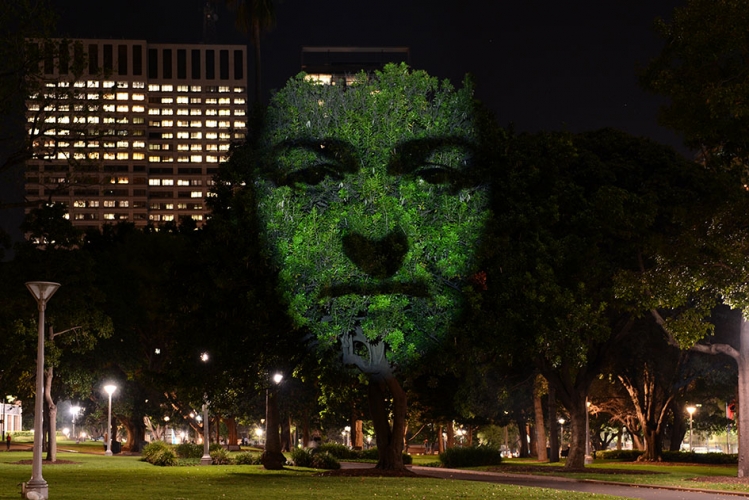
I chose to look into the works of Clement Briend and Craig Walsh, who both have worked with projecting onto trees. I am drawn to the projection onto trees because I love trees, and because it is intrinsically interesting due to the fact that this object is not stationary (moving branches and leaves) or flat, and so would present a challenge to the artist in some way.

Clement Briend is a French photographer who delves into projection installation. He has done two series of these projections onto trees: one of gargoyles on trees near Paris, and the more famous one being the projection of Buddhist spirits and deities onto trees in Cambodia.


His works attest to the connection between the real and the imagined, or how the ephemeral that cannot typically be visually seen, can be displayed in the world. In his series focusing on Cambodian trees, he projects his photos of sculptural works that relate to spiritual beliefs in Cambodia, and projected them onto the real world, where these spirits are believed to reside. He reimagines the space, and transforms it into a place where the invisible and the magical can be physical and visual. 

I understand the intent of Breind's work, but I am curious about the exact message of his work outside of the context of reworking the reality of the space. Why only religious imagery? And how will the Cambodian people reimagine this space in a few years?

Breind's works peak my interest because I can identify with the need to have people recognize and visualize the spiritual in the world of the natural, keeping in line with the goals of my projects this past year. I would love to make the trees in QA woods come alive by having faces and whispers come out of the forest because during my first two years of college, I would walk through those woods and speak my thoughts to the trees, and felt that the trees were alive and responding. I want to transform the space into a friendly place, and not a space in which fear needs to be the overwhelming feeling while one is walking through the woods as it has been in the past. I am not sure that this space would be particularly ideal, though seeing as how it is now well-lit and somewhat out of the way for viewers.  

Craig Walsh is an Australian artist who is well-versed in projection art, though he has many other talents. He has done a work projecting storytellers onto trees in Sydney's Hyde Park South in which he celebrates the area as a place where several protests have happened historically. Three faces, that represent different social change movements, were projected onto the trees, and they spoke of the place's history throughout the duration of the work.
2012-10-08-slide_255421_1615230_free.jpeg


I think this work does a good job in tying together place and meaning, while transcending time. The park in itself is a monument to its historical past in relation to social change movements and protests, but there is not necessarily a memorial. The park continues to be a gathering place in which social interactions between groups of people continues to influence the future of the people as a whole. To attest to the park's history while also addressing the fact that social change is still important and relevant to this day transcends the time restrictions of the project.

This work made me think about doing a projection art project about the different faces of St. Mary's in light of the negative incidences that have happened regarding discrimination and harmful stereotyping, as well as the group I am involved in that is attempting to address this issue. I could project different faces that tell their stories and how they represent the St. Mary's campus.

I was also very interested in a project by Miwa Matrayek, Myth and Infrastructure, in which she combines projection and performance by having her shadow interact with the projections. The combination is an impressively-timed performance piece that creates a sense of magic and mystique that would only normally be seen in animation or movies. The combination of the real and physical performance with the projected, creates a surreal atmosphere and allows the viewer to explore the division between the real and the unreal. I enjoy the interactive aspect of the piece and would love to find a way where anyone can enter themselves into the projection piece.

I was thinking about making a commentary about "fitting in" where a person has to try to fit their shadow inside a silhouette projected onto a building by standing closer or farther away from the light. The place where this person would stand would get a piece of tape to mark their place. I'm not sure where else this would go, or how to finish this thought yet.

http://thecreatorsproject.vice.com/blog/french-photographer-uses-projections-to-explore-link-between
http://craigwalsh.net/projects/view/Art-and-About-Festival-Hyde-park-Sydney/

Monday, March 31, 2014

Reading Response- Murti

Krisna Murti's article, New Media: Guerrilla Culture to Gadget Art, responds to the different modes of thought and benefits to new media in the face of criticism and fear or misunderstanding of the new medium. Murti talks about how people have viewed digital media as a danger and threat to society: many of these opinions remain strong today. For example, there is the fear that social interaction is a skill that is waning due to the distance created by technology, or that technology sets a bad example for the younger generations in terms of violence. Certainly, this fear is a cycle that will continue to be renewed with the introduction of something that has not been seen before; even comics were an art form that certain generations were skeptical of.

Murti illuminates the positive aspects and underlying messages of digital media even through examples of the more offensive or harmful products of digital media. The bombing in Indonesia set off by a cell phone ring, and cyber-hacking to release secret or censored information are two examples that might be seen as extremely dangerous, and exhibit a strong argument for why new media and technology is negative. However, Murti defines these examples by transforming their negativity into potential for the positive. The bombing in which the bomber did not need to be present is an example of alternative presence in real time- the person does not have to be present in the actual space to have an effect. This crosses into boundaries of social media like Skype, and even artistic interactive spaces where the art and program of a project can interact and change with the viewer and audience while they are viewing the piece. Cyber-hacking is a way of rebelling against overpowered authority and placing authority and clarity into the hands of the common person. Art does this by making the tools to make digital art readily available to anyone- such as the ability to create video, GIFs, websites, post photos outside of a gallery setting, etc.

While these examples may be controversial, there are important insights into these ideas. I was especially intrigued with the ideas of time and how digital media creates a flexible gallery space in which time and space can be flexible in terms of the presentation of the material. I also began thinking about the contradiction related to the sense of time and space in digital media and technology especially in relation to the website that I have made. While web spaces can be considered to be permanent and timeless spaces for a piece of work or information, and that this is a place where people can access the information on this site always, the way in which the industry and new media art grows means that there is consistent and rapid change. The access and viewership of these pieces transcend time, but they cannot always transcend interest and modern culture, which is something that has to be continually reconciled to make work, and even the medium relevant for an extended period of time.

Sunday, March 30, 2014

Self-Assessment Two

This project is a combination of two different processes: 1) improving the web design of my website, and 2) creating three more stop motion animated commercials in continuation of the first project. I hoped to finish the most work-intensive and central component of my publicity campaign for the Campus Farm, and I succeeded in doing so. Because much of the process for making the animations was very similar to what I talked about in the first self-assessment, I will be focusing on the improvement of the website, which was inspired by the unattractive layout that I had made last semester.  The website was too dark, the color scheme was not visually pleasing, and the buttons on the home page seemed to create disorganization on the page.

I began by looking into websites that were much cleaner, such as my friend’s template website, The Young Catholic Woman. My first design was inspired by a desire to illustrate the earthiness that I was promoting, but the picturesque background of dark soil seemed to be a dated and dark method of doing so. I found the cleaner, and lightly-colored websites to be much more attractive. So, I began to work with Adobe Kuler for a more pastel color scheme. This part of the process was incredibly time-consuming, and required hours of playing with different shades, tones, and color combinations. I looked into premade color schemes, and considered color options that I had not previously, such as purple, blue and yellow earth tones, and this opened my mind to different color options. I ended up using a Digital Color Meter to extract lighter shades from my main image on the home page in order to gather the colors that I needed, and noted their Hex numbers. My color scheme relies predominately on three colors: white, olive, light green, and dark brown.

Next, I needed to better organize my site. I enjoy the consistency of a banner and navigation bar along the top of the page to give every page solidarity and cohesiveness, and ease of navigation at all times. The hardest part of this process was creating a rollover navigation bar using CSS. I attempted to create this navigation bar several times, using different references, but succeeded in finding a very user-friendly YouTube video byMohit Manuja. I had issues centering this navigation bar though, so I had to use an additional source that told me to separate commands for the “ul” and the “li” aspects- I still do not fully understand this concept, but I do know that it worked.

The last part was to build the banner. I wanted to keep an earthiness to the site, but without overwhelming the page with realistic images. So, I took a picture of basil and made it black and white, overlayed a transparent layer of the light green on top of the image, and then painted the edges of the image so that it would blend better with the background of the webpage itself. I used a cursive font for the title so that it looked journalistic and handwritten, to reflect the journalistic nature of the written content.

I spent a large portion of time solely on the web-editing aspect of the design in order to ensure its professionalism and aesthetic appeal. There were many times that I wanted to give up on different parts, but I was able to pull through, and even search for alternative resources when others were failing me. I should have used the TA option more heavily, but I was insistent and pride-driven to figure this out without much guidance, which is folly. I believe my time was well-spent, and contributes to a large success in the inviting appeal of the website as a whole.

The final product is definitely more cohesive and attractive than the original. The color scheme is lighter, warmer, and more reflective of the spiritual and healing atmosphere that I am trying to convey with the project as a whole. It is more organized, and easier to navigate by eliminating the necessity to return to the home page for navigating the website, and allows the audience the ease of skipping around the pages without extraneous clicking. There are a few edits that I still need to make in terms of making the site more pleasing. The videos needs to be larger to emphasize the artwork that I slaved over and to show the reader that this video is just as important, or related to the writing below it. There needs to be a minimum and maximum window size setting so that the writing does not become too close together if the window is too thin, and the content of the page is not overwhelmed by the green-to-white gradient background if the window is too large. I also need to fix the pictures hanging over the bottom line of the writing section.


I think that my project is cohesive and inviting, and I hope that my audience will appreciate it in the coming month. I believe that I deserve an A for my efforts.

Sunday, March 2, 2014

Website Research

So, my goal for this project is to do more of the animations and to tweak my website to make it look better. I have chosen a couple of websites that have the basics of what I want the end product to look like.

Last semester, I chose Paravel as a website that I enjoyed the taste of. I still want to keep this model of organization.

Within the site is a portfolio of different sites that the team has worked to create. The layout of the site is very simple, using black and white rollover images in a grid layout to organize their works. After clicking on their images, you are taken to a new page where they have a large image capturing the design of their sites. 


      Below the main image, the page is divided into several small sections by a simple gray line. Each section contains small captures of aspects of the sites they create, and then simply describe the process of their designs. Their images are very clean, but they add in elements of "homemade" which is most likely Ray's doing. 


       They create responsive web sites, which are supposed to be very easy to use and available to resize on several different technological appliances, so they make good use of Div Tags, as opposed to AP Div Tags, which is a good choice in a time where smartphones and tablets are becoming more popular in use. Their simple and sleek web layout is attractive, easy to read, and easy to negotiate. 

I also wish to emulate the journalistic blog style of my friend, Carolyn, who used a template to build her website The Young Catholic Woman. She adds a lot about her personal anecdotes and opinions, and she ends up having lot of writing, but this is successfully broken up by large pictures that help to add visual content. Sometimes her visuals are interesting because there has to be a forced connection between the visual and the written context, this connects with the Osborne reading that we did about how we receive art in distraction, and how art is distraction.

For websites, where the general idea of being online is an inherent distraction because there is such easy access to alternate information, the tone of websites and the affected culture of reading seems to need a lot of visual content to help distract the reader every once in a while in order to maintain interest in the information. Carolyn's use of large pictures that alternate sides of the blocked text area succeeds in this type of distraction.

Monday, February 24, 2014

Self-Assessment 1

          This is an advertisement for the Campus Community Farm as part of the aspect of my SMP where I implement a publicity campaign for the farm to get people to experience the spiritual benefits of gardening. This project will ultimately be shared on my website, and also as a projection on the day of my SMP presentation.  This particular commercial is supposed to share the importance of the gardening ritual of planting. Planting is something that has been done since before the beginning of agriculture, and the metaphor of planting extends into the metaphysical and mental aspects of our everyday lives. Humans and plants are connected by this metaphor. By animating a person and a plant growing out of a seed, I wanted to show that both are capable of growth, separately or together. The abstraction of the animation would allow for the possibility of a human growing out of a metaphorical seed, developing into a better person, but also the rate of growth together would mean that this process of planting helps to create a relationship with the surrounding environment. The background of the live action stop motion helps to enhance the context of the farm.
            I used four programs in order to create this project. I started with Photoshop to resize the photographs that Sam helped me to take at the farm of my hand planting a seed in the ground. This is where I learned how to use the “Actions” feature on Photoshop, which saved me a significant amount of time in other endeavors, such as adding a green backdrop to my illustrated frames. I then used Illustrator to draw my animated frames. This was the painstakingly long and arduous step of creating the piece. I was expecting to make at least 80 frames of hand-drawn Illustration for fluidity, but I ended up only drawing 38 frames of the human and seed growing. Toward the end, I think the growth happened more rapidly, perhaps creating a choppier and quicker transition than I had earlier anticipated. I had to sacrifice some fluidity and slower action for my own sanity and for time’s sake. I also learned how to delete particular sections of the pen lines using the white arrow tool in addition to using the warp tool to manipulate my images for subsequent frames. When using the white tool to delete and recreate lines, however, I had to be consistently wary of the lines not meeting at the right point because this small mistake would cause the image to be transparent in the incorrect place. Using only the warp tool made my lines very wavy and hard to smooth out, but it worked wonderfully for the degradation of the seed pod and its shadows. I then used iMovie to create separate projects for the live action planting stop motion and the illustrated animation. iMovie is incredibly user-friendly, and it offered basic overlay features for creating the movie.  The first one I tried was the cut-out effect, which was terrible. Basically, the clips cut from one clip to the other, and overlay can occur when the opacity levels are tampered with. However, there is a black or white film on the overlay clip, which did not offer the aesthetic I was looking for. iMovie also has a green screen effect; however, iMovie automatically cuts out a certain portion of the image in order to compensate for the deletion of the green, which did not serve well for maintaining the thickness of my lines. In all reality, I probably could have used iMovie entirely for the creation of my project, but I decided to use Final Cut Pro instead. Learning this program was interesting and not incredibly difficult for my purposes. It was a lot more flexible than iMovie in terms of giving me more effects options and manipulating the clips. Instead of the green screen effect, I ended up using the Chroma Keyer to key out the green, adjusting the luma and saturation levels to key out the Photoshop green background from my images. This was incredibly easy. Achieving the zoom feature correctly and flawlessly was more difficult because I had to zoom in exactly the same for the five “GROW” stills so that the word “GROW” did not move on screen. Once I figured out that the coordinates could be typed in rather than merely dragging the red cross, I was incredibly relieved. Adding in the audio was not difficult, but picking out the music itself was a painful process. I downloaded my audio from Creative Commons, via the website Free Music Archives.
            I went to the Mac Lab to work on this project at least every other day for three to five hours at a time, in addition to in class studio hours. Aside from the plaster sculpture I made two years ago, I have not spent so much time on a single art project. Though I was familiar with most of the programs that I used, there was still a lot of learning that I had to do, which was incredibly frustrating and took up much of my time. Much of my time was spent looking up instructional tutorials because I was determined to attempt to figure out the inner workings of simple solutions without additional help. The Internet was my Godsend, in addition to the help of Sam and Billy. Once I figured out easier ways of working the animation, the process of my illustrations became much easier, and making the animation a little choppier and sacrificing some fluidity definitely helped to save time.
            The commercial is successful in its intended purpose of advertising the farm. The beginning of the commercial starts with a story, drawing people in with a singular hand. The purpose of this faceless hand was to help the audience identify with the hand in some way, and to serve as a metonym for the whole person. The music starts out slow, but changes with the introduction of the illustrated animation. The slow piano marks the slower and less dynamic action of planting the seed, while the accordion crescendos with the growth of the seed, enhancing the fantasy of the seed and human bursting from a seed pod.  The text slides change at the start of each measure of the musical piece, introducing a dynamic change where one would be expected to happen. The audio was a last minute decision, and a decision made without much confidence, that effectively helps to improve the quality and tone of the commercial. The overlay of animation on top of the live background contextualizes the commercial, and also maintains the earthy atmosphere where the transformation and growth suggested is expected to happen. The mixture of reality and illustration serves to make the transition between physicality and mindfulness, noting that the physical action results in a nonvisible transformation. The white color of the animations also serves to provide a nice contrast from the dirt; the white is pure, clean and smooth, while the dirt is rough, shaded, and consistently shifting. This notes that though the farm is a very dirty place, there is still some sense of purity there. An accidental success of the piece comes from the background shifting while the text is on screen, so as to make the commercial consistently dynamic and changing throughout, rather than ending on a very static note. Overall, the commercial seems to be a success. There are a few things that could be improved, though. First and foremost, the sizing of the video does not translate well expanded, and should have been fitted to an HD screen. Secondly, the words “Life”, “Energy”, “Food”, and “Together” are in a darker shade of black than the rest of the outlines in the animation. This does not help with the sense of unity of the animations and also makes these words stand out more than everything else. However, this might be an accidental success because it adds additional focus to those words instead of “GROW”, which is a word that remains static throughout those four frames. I am also wary of how the word “GROW” expands on the frame. It seems somewhat cheesy in the film, and transitions like a Prezi presentation, which I had hoped to avoid. I don’t know how else the transition could happen though.

            I believe I deserve an A on this project. I put a lot of effort and time into this project, and was willing to learn a lot about the different programs. I did not effectively fix the project to fit an HD screen, nor was I attentive to the image sizing in the beginning either, but despite that mistake, I think that enough time and effort was put in to deserve an A.