


I chose to look into the works of Clement Briend and Craig Walsh, who both have worked with projecting onto trees. I am drawn to the projection onto trees because I love trees, and because it is intrinsically interesting due to the fact that this object is not stationary (moving branches and leaves) or flat, and so would present a challenge to the artist in some way.
Clement Briend is a French photographer who delves into projection installation. He has done two series of these projections onto trees: one of gargoyles on trees near Paris, and the more famous one being the projection of Buddhist spirits and deities onto trees in Cambodia.


Craig Walsh is an Australian artist who is well-versed in projection art, though he has many other talents. He has done a work projecting storytellers onto trees in Sydney's Hyde Park South in which he celebrates the area as a place where several protests have happened historically. Three faces, that represent different social change movements, were projected onto the trees, and they spoke of the place's history throughout the duration of the work.

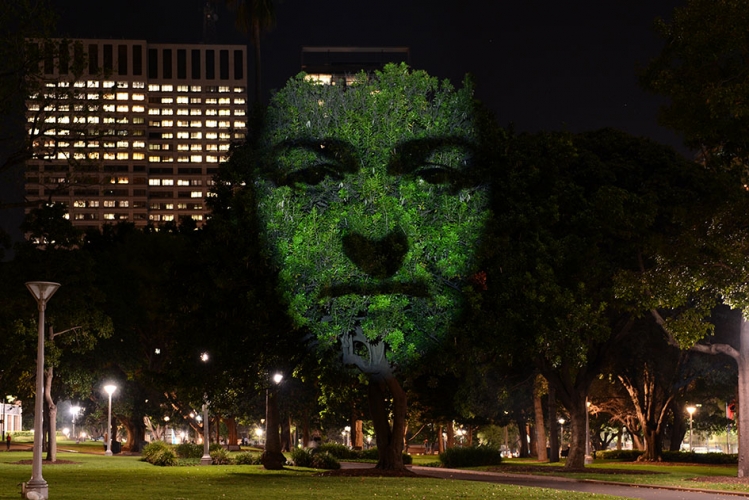
I think this work does a good job in tying together place and meaning, while transcending time. The park in itself is a monument to its historical past in relation to social change movements and protests, but there is not necessarily a memorial. The park continues to be a gathering place in which social interactions between groups of people continues to influence the future of the people as a whole. To attest to the park's history while also addressing the fact that social change is still important and relevant to this day transcends the time restrictions of the project.
This work made me think about doing a projection art project about the different faces of St. Mary's in light of the negative incidences that have happened regarding discrimination and harmful stereotyping, as well as the group I am involved in that is attempting to address this issue. I could project different faces that tell their stories and how they represent the St. Mary's campus.
I was also very interested in a project by Miwa Matrayek, Myth and Infrastructure, in which she combines projection and performance by having her shadow interact with the projections. The combination is an impressively-timed performance piece that creates a sense of magic and mystique that would only normally be seen in animation or movies. The combination of the real and physical performance with the projected, creates a surreal atmosphere and allows the viewer to explore the division between the real and the unreal. I enjoy the interactive aspect of the piece and would love to find a way where anyone can enter themselves into the projection piece.
I was thinking about making a commentary about "fitting in" where a person has to try to fit their shadow inside a silhouette projected onto a building by standing closer or farther away from the light. The place where this person would stand would get a piece of tape to mark their place. I'm not sure where else this would go, or how to finish this thought yet.
http://thecreatorsproject.vice.com/blog/french-photographer-uses-projections-to-explore-link-between
http://craigwalsh.net/projects/view/Art-and-About-Festival-Hyde-park-Sydney/
Clement Briend is a French photographer who delves into projection installation. He has done two series of these projections onto trees: one of gargoyles on trees near Paris, and the more famous one being the projection of Buddhist spirits and deities onto trees in Cambodia.
His works attest to the connection between the real and the imagined, or how the ephemeral that cannot typically be visually seen, can be displayed in the world. In his series focusing on Cambodian trees, he projects his photos of sculptural works that relate to spiritual beliefs in Cambodia, and projected them onto the real world, where these spirits are believed to reside. He reimagines the space, and transforms it into a place where the invisible and the magical can be physical and visual.
I understand the intent of Breind's work, but I am curious about the exact message of his work outside of the context of reworking the reality of the space. Why only religious imagery? And how will the Cambodian people reimagine this space in a few years?
Breind's works peak my interest because I can identify with the need to have people recognize and visualize the spiritual in the world of the natural, keeping in line with the goals of my projects this past year. I would love to make the trees in QA woods come alive by having faces and whispers come out of the forest because during my first two years of college, I would walk through those woods and speak my thoughts to the trees, and felt that the trees were alive and responding. I want to transform the space into a friendly place, and not a space in which fear needs to be the overwhelming feeling while one is walking through the woods as it has been in the past. I am not sure that this space would be particularly ideal, though seeing as how it is now well-lit and somewhat out of the way for viewers.
I think this work does a good job in tying together place and meaning, while transcending time. The park in itself is a monument to its historical past in relation to social change movements and protests, but there is not necessarily a memorial. The park continues to be a gathering place in which social interactions between groups of people continues to influence the future of the people as a whole. To attest to the park's history while also addressing the fact that social change is still important and relevant to this day transcends the time restrictions of the project.
This work made me think about doing a projection art project about the different faces of St. Mary's in light of the negative incidences that have happened regarding discrimination and harmful stereotyping, as well as the group I am involved in that is attempting to address this issue. I could project different faces that tell their stories and how they represent the St. Mary's campus.
I was also very interested in a project by Miwa Matrayek, Myth and Infrastructure, in which she combines projection and performance by having her shadow interact with the projections. The combination is an impressively-timed performance piece that creates a sense of magic and mystique that would only normally be seen in animation or movies. The combination of the real and physical performance with the projected, creates a surreal atmosphere and allows the viewer to explore the division between the real and the unreal. I enjoy the interactive aspect of the piece and would love to find a way where anyone can enter themselves into the projection piece.
I was thinking about making a commentary about "fitting in" where a person has to try to fit their shadow inside a silhouette projected onto a building by standing closer or farther away from the light. The place where this person would stand would get a piece of tape to mark their place. I'm not sure where else this would go, or how to finish this thought yet.
http://thecreatorsproject.vice.com/blog/french-photographer-uses-projections-to-explore-link-between
http://craigwalsh.net/projects/view/Art-and-About-Festival-Hyde-park-Sydney/
