Pages

Subscribe:

Labels

Monday, December 9, 2013

Video Game Gala of Doom

I attended the "Game Design and Development Project Gala of Doom" held in Schaefer, and was pleasantly surprised by the quality of the games created by the students of the class. Let this be my disclaimer that I am not very knowledgeable about games, nor am I very good at playing them successfully. I played Nanaquest, Iron Dust, King of Nunn, and the Natty Boh Hunt with the assistance of my friend.

All of the games featured a very basic directional keypad with button for jumping, and typically featured a shoot button. The Natty Boh Hunt bragged a focus on nonviolence, and so did not have a shoot button, but the point of the game was also to make your way through the game while getting increasingly drunk. I give them extra points for originality, flare, and attention to the local culture. I really enjoyed playing all of the games; they all had an interesting balance of playability and difficulty, and they were all very fun. I do have to say that reading all of the text in King of Nunn was too overwhelming.

Focusing on the artistic elements of the games, I enjoyed the colorful aspects of Nanaquest because it deviated from the stereotypical presentation of a space setting being dark black with white spots and the occasional asteroid. I'm referring to Galactica and similar games, just because those are the only space games that I tend to enjoy. Contrastingly, Nanaquest featured the characters playing on the actual planets, in wildly colorful settings. The color schemes seem to be toxic or neon, getting across the fact that these settings are otherworldly. For some, the amount of color might be overwhelming, but I think the students did a good job of making sure that the main characters could be easily viewed in a prisoner orange spacesuit, that could contrast well with the contrastingly muted background. However, I did make it past the second level, so this may have changed later on in the game.

The design of Iron Dust was lovely, and fit well with the theme of the game, in which the main character is trying to avenge his decimated village. Once again, color played an important theme in the design of the game, with the setting being a series of muted browns, tans, and dull blues. I especially enjoyed the towers that looked as if they'd been slightly rusted and in the process of falling apart. They added a good dimension to the game while also being functional. Every part of the game looks carefully handcrafted, and that is something rarely found in today's games. Due to this overall tone of the game, I struggled with accepting the style of the "Next" button, which is reminiscent of the style of selection buttons on the game systems of Playstation or Gamebox (I can't remember which one). I wish the overall handcrafted tone of the game was kept even in small elements such as the "Next" button.

Natty Boh Hunt's design is very interesting and I have never encountered anything like it. Basically, there is no gravitational direction once the character is inebriated, creating a very trippy effect that is not as stereotypical as this. The background is a very pixelated picture of the campus stretched out to fit the entire design, and on top of the digitally illustrated pathways, there are pictures of real trees. While any other attempt to recreate this kind of design would be unpleasing, the context of the game allows for, and even necessitates such an unorthodox creation. In addition to the lack of gravitational pool, it was discovered that the character could not die and whenever he fell, he would end up in another part of the campus. This accurately and hilariously reflects the false notion of a drunk college student that they are invincible. The humor in this piece was very enjoyable.

Monday, November 25, 2013

Paravel Web Design


     Paravel is a web design and branding agency comprised of three men- Reagan Ray, Trent Walton, and Dave Rupert. They all contribute to the web projects in their own ways, but it seems that Reagan Ray is the graphic designer of the websites, judging by his individual portfolio site where he displays a lot of his branding designs. I was attracted to the "handmade" feel to his artwork, especially on the first page of the Paravel website because I intended to have the same effect for the homepage of my own website.
Home Page of Paravel
    
      Within the site is a portfolio of different sites that the team has worked to create. The layout of the site is very simple, using black and white rollover images in a grid layout to organize their works. After clicking on their images, you are taken to a new page where they have a large image capturing the design of their sites. 


      Below the main image, the page is divided into several small sections by a simple gray line. Each section contains small captures of aspects of the sites they create, and then simply describe the process of their designs. Their images are very clean, but they add in elements of "homemade" which is most likely Ray's doing. 


       They create responsive web sites, which are supposed to be very easy to use and available to resize on several different technological appliances, so they make good use of Div Tags, as opposed to AP Div Tags, which is a good choice in a time where smartphones and tablets are becoming more popular in use. Their simple and sleek web layout is attractive, easy to read, and easy to negotiate. 


      I hope to design a website with a similar design. For my homepage, I have an image with a homemade feel, like theirs, comprised of rollover images that will take the viewer to a new page elaborating on each section of the site. Below that, I hope to take inspiration from their site and create small sections in which I take sections of my art pieces as visual representations of each section of my writing. I will be more cautious about the size of my font, however. I think that the font size of Paravel is obnoxiously large, and distracts from the display of their work. 


Thursday, November 7, 2013

The Queen of Jazz

My take on Ella Fitzgerald using Illustrator for the meat of it, and Photoshop for the blur effects. Listen to "All the Things You Are" to get the full effect/hear the inspiration.


The original

Tuesday, November 5, 2013

Life=Game=Life

Much of the article "Identify Yourself" by Krystal South repeatedly alludes to the sexual experience on the Internet. This experience has larger roots in that it is easy to recreate your identity online and to interact with other people without the added pressure of dealing with preconceived notions about your identity, or emotional (or lack thereof) response, or awkwardness.  Because of this, the Internet creates a forum where people can feel safe exploring the taboo or the uncomfortable with little consequence.

Jon Rafman's Kool Aid Man in Second Life- Tour Promo and Daniel L. William's Sweet Treatz successfully display the disturbing, but the very real experience of fulfilling a fetish online, whether it be bestiality or celebrity worship. In the Life=Game section, South says that"[The Sims and Second Life] involve the transference of identify into a virtual space that, in effect, mirrors our own. The control of the user is complete; he or she can create, manipulate, or destroy their characters without consequence to their real lives. They can engage in play and socialization that may be restricted in their real lives, providing cathartic experiences that are free and open-ended. They push the idea of escape, present in all media consumption, to an active role over which they have control."

In thinking about Jung's interpretation of the psyche, he outlines five archetypal characteristics within a person. In these are the persona- the mask one wears for society, the shadow- the aspect of the self that is not socially acceptable, and the self- the true individual identity that helps to reconcile these different archetypes.  In applying these ideas to the concept of finding control within a world that is not real to everyone else, one could argue that the person who finds his niche in a gaming world is letting the shadowed aspect of himself take over for a while, satisfying his disappointed need to have autonomy over his Earthly life within the Internet life. Sex can be a taboo subject, and one in which people attribute to their darker personality. Having virtual sexual experiences reconciles this socially unacceptable desire with proper social conceptions, resulting in the creation of a normal persona not soiled by taboo fetishes and a second self that is able to fulfill them without consequence.

The section about how game=life This section of the article reminded me of the lecture with Brock Rough about how video game criticism is difficult.  Rough and South both seem to draw upon a similar conception of experiencing video games as a finite world in which the player has a certain level of autonomy, and can self-create fictional interpretations about the fictional truths presented in the world of the game. South says, "Playing games online, competing against other human beings, means that there is no clear pattern. New opponents have their own strategy, strengths, and weaknesses. Every game has its own goals and measures of success. Some games require teamwork while others require the player to think alone on their feet." There are several variables to the reality of the game world that influence the paths that the first player can take just as his own decisions influence the outcome of the game. There are finite options, but knowing all of the outcomes can never occur even with life regeneration in video games.  The experience of choice and options is similar to an "Away from Keyboard" experience or IRL.

That South notes how playing video games is an avenue for people to regain a sense of autonomy over the outcome of their experiences notes a sense of insecurity in away from keyboard life.  The video games provide a second life for the gamers that gives them a semblance of control over that life in a way they cannot be confident in applying to their lives outside of the computer.  Now, is this sense of control false? It is certainly real for the players, but it is not necessarily applicable for others outside of this world.  

Tying this with the other section, it seems that one's experiences away from the keyboard give reality and purpose to the world of the Internet, but the Internet also gives the same back. There is a deep interconnectivity between the two, which makes it hard to dichotomize the ideas of determining reality and identity away from and involved in the computer.


Wednesday, October 23, 2013

Brock Rough Lecture

    This is a quite late submission for this blog post about the artist lecture on October 9, but I hope it is still acceptable.
    On October 9, Brock Rough from the University of Maryland came to give his lecture "Why Video Game Criticism is Hard". Rough began his studies in Art and then ventured into philosophy.  his lecture did not focus much on video games themselves; he did mention that his lecture could be applied to many other arts other than video games. So, his lecture seemed more philosophically-based than art-based.
    Rather than going into detail about the outline of Rough's lecture, I will give my reactions to his lecture and explain what I found particularly interesting. After establishing definitions for fiction, props, and narrative, Rough outlines the basis for two different worlds that are portrayed in art- the work world in which the reality is defined by the environment, and the game world in which an individual's freedom to make-believe in context of the work world determine's that virtue. So, in other words, each individual understands the work world as influenced by their own established beliefs or fictions about said world. This is not a foreign concept to people seeing as how truth can be relative, and personal experience nurtures one's perception of a work.
    However, the lecture became more interesting with the introduction of the ideas of primary and indirect truths. I enjoyed his example of these truths in stating that a primary fictional truth is one directly stated by the work, such as "this is a person", whereas an indirect truth that depends on the foundation of primary truths could be something such as "that person has blood in their veins" though that is something that cannot be proven in the fictional world.
    Without going into the more complex and extraneous terms and issues that Rough introduces about why video game criticism is hard, I will attempt to summarize his conclusions based on this information.  When there are multiple people playing a game in which the world is fictionalized, each individual is going to experience this playing field differently because they interact with the fictional truths of the world based on their own prior experiences. Therefore the nature of the game world is further fictionalized by the interpretation of the player's own make-believe, or interpretation of indirect truths.  Therefore, the established overall truth of the game world is not stable or the same for everyone.  Furthermore, the game worlds often have multiple outcomes in their story-lines based on the decisions that the individuals make in the game world. The plethora of options and outcomes makes it very difficult for people to experience every possible play in a game, thereby further increasing the range of experience of individual players. There is also the combination of player experience with the advent of Massively Multiplayer Online Role Playing Games (MMO RPGs).  In this, multiple people are influencing the outcome of each other's experiences, such as in Guild Wars 2 where another person stepping in to help in combat may effect your experience by decreasing your chances of earning experience points, or increasing your chances of survival.
    The infinite of outcomes makes knowing how to determine what defines a sufficient level of experience of a game in order to give a credible critical response to the game. If there are infinite outcomes, how much time does one need to spend playing a game in order to know the game to an extent in which they may give a well-researched criticism of the piece. Rough proposes becoming more determinate in creating this distinction, but I question how possible this is given the fact that there are very few people who are willing and able to play a game multiple times in order to gain greater knowledge of a game. And, how well do those experiences sufficiently reflect common criticism for the population at whom these games would be targeted, or by those who would buy them? How would better criticism affect the marketing of these games?
    The content of the lecture was great and and complex, so Rough needed more time in which to fully grate upon his ideas and definitions, especially given the diverse crowd that attended the lecture, but his ideas are fascinating and great because they are extensive in application.


Abstract Colors

Alessandro Pautasso, a.k.a. Kaneda, is a graphic designer and illustrator based in Italy. His specialties are in vector art and mixed media. Interestingly enough, his interest in design and illustration was sparked by the discovery of Alan Aldrige's illustration book about the Beatles, and thereafter he worked in commercial art and digital art.  I am intrigued in this artist's work, not because I wish to utilize his methods in my work, but because I admire his since of color, an aspect of art I feel inferior in.  In his series "Abstract Colors", he uses a very wild color scheme to recreate portraits of old Hollywood stars, such as Bette Davis and Frank Sinatra. His color scheme is reminiscent of a pop-punk 80's color scheme, which would probably be more appropriate for 80's Hollywood stars, but in any case, his sense of color and line in creating these wild portraits is quite amazing in my opinion. The way the colors are combined in order to create an obvious sense of depth is confusing, but effective. His use of small lines in order to create texture, especially on the iris, the lips, and the eyebrows is also lovely. Because I admire the texture, the use of texture lines will be considered in the making of my portrait of Ella Fitzgerald.

In regards to his color scheme, I am slightly confused about why he chose the color scheme for this subject matter. The use of these colors does alter the natural color scheme, especially for a time that in most people's minds seems so classic and natural.  However, the color scheme does not enhance the meaning of the work for me. 

It does inspire me to look into popular color schemes for the 1930s-1950s for the background I will create for Ella, to be inspired by her music. The composition of Pautasso's shapes and the theme of squirls in his other works also give me other ideas about how to configure my interpretation of the music. The somewhat chaotic, yet clearly organized manner of the composition reminds me of the way jazz music is composed: there is an aspect of previously composed musical pattern with the addition of chaotic improvisation.


Frank Sinatra

Bette Davis


Tuesday, October 8, 2013

Portraits

I have found that I am really drawn to the very active self-portraits. These portraits can show the semblance of action by a mere toss of the head as we see in Bob Marley, or as if the person just turned their head to look over their shoulder as in Rembrandt's portrait, the old man's portrait or the drink stain woman.  The way in which the color application is done also creates a great sense of action too, which I particularly enjoy. The color and the texture can also help to define the person within the portrait.  In the portrait of the green lady, everything is a muted green and the texture is very fluid, which plays with her fluid motions, making her seem like a calm and graceful character. The flower around her also creates a helpful addition to defining her character, and if I were to add anything in my portrait, I would do it in this way because it seems to create a nice balance between the outer and inner/atmospheric self. The clear sense of lighting in all of them are really attractive too; most have a lighting that directs the viewer directly at the center of the face, highlighting around the eyes and part of the forehead. 

http://files.sharenator.com/portraits_made_out_of_used_joint_filters_01_Portraits_made_out_of_used_joint_filters-s550x686-60650-580.jpg
http://www.cruzine.com/wp-content/uploads/2013/06/001-amazing-digital-portraits-yuehui-tang.jpg
http://queue.typepad.com/.a/6a00d8345293e069e20133ef6049d4970b-pi
Portraits Drawn with Tea, Vodka, Whiskey and Ink by Carne Griffiths portraits illustration drawing
http://www.thisiscolossal.com/2012/10/portraits-drawn-with-tea-vodka-whiskey-and-ink-by-carne-griffiths/

http://www.visualnews.com/2012/06/12/outsiders-beautiful-portraits-of-the-overlooked/

Project 1


Friday, October 4, 2013

Peter Beyls

I felt initially drawn to Peter Beyls' works because his pieces seemed to be more organic and abstract without being constrained by straight lines.  Peter Beyls is a Belgium artist and composer; his goal in his artwork is to show how digital media and computers are related to the creative process. In the article, Beyls is quoted as having created an early computer-generated model of how people draw with an Untitled piece in the EWA series.
Untitled, EWA Series
I enjoy the works that have bright and saturated colors of his works, as if he is really trying to highlight the way in which the repeated algorithms change. The saturated nature of the colors also contrasts with the natural inspiration of his pieces. In each work, certain aspects of the artwork are accentuated by darker contour lines. The compositions have very clear intentions about how the eye is supposed to move around about the piece. In SwingArm, there is a defined curve and in Pinball Machine, the motion of the art spreads outward.  I am amazed at how algorithms can be calculated to create such organic movements such as the curved swing of an arm and the formulated circular scatter of pinball points.  Typically, mathematical formulas are thought of as being very straight and constricted. 

Beyls' works are also inspired by his compositions- his interactive audiovisual installation is intriguing because he is directly applying the intent of displaying the creative process and physical movements of people.  The multi-sensory aspect of this piece can also address synesthesia because the audio becomes a visual representation. It raises questions about how computers influence human movement or how calculated the human body is.


Sunday, September 29, 2013

Laughing Bones

I perused RedBubble, an online marketplace where people can buy artwork submitted by the original artists. Upon looking at the work of the user Laughing Bones, I felt as if his art related to the aims of my art because of its intentions.  Many of his works seem to be social commentaries about how our lives are affected by very influential factors such as the government or drugs, while my art is meant to be a social commentary about the evolution of technology within our food system.  His art is also relatively simple and seems to be based in re-appropriation of images and becomes very surreal. The images are disturbing because of their meaning and because of their odd mixtures of images.

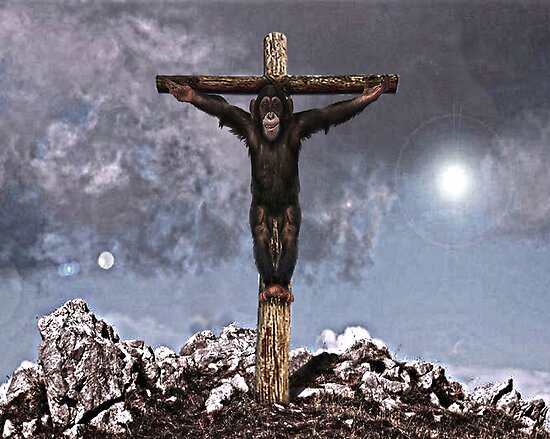
My favorite example is "Religolution" which combines two ideas that are supposed to be contradictory- Evolution and Creation- and meshes them together in a way that shocks the eye.  It seems blasphemous and displeasing to look at because the social importance placed on the image of Christ has been marred by the replacement of his figure by a monkey.  The idea that both Evolution and Creation can coexist is an accepted idea, but seeing them in this form calls into question whether they really can coexist in our beliefs.  There are contradictions within the stories of Genesis in contrast with the theories of how humans developed that must be thought out before being widely or blindly accepted.

Just so, I wish to achieve the same affect in my artwork.  In images such as the one in which a tomato is being injected with a fish (representing flouder DNA), the true nature of the tomato is called into question.  That this tomato is a genetically-modified organism and has become a normal thing in our society displays the widespread acceptance of how technology and food coexist.  Food is a natural thing, yet we can also create artificial foods. Can we be healthy or consume natural foods if we are altering our food? Is the existence of technology within our food system dangerous or beneficial? Is organic food a better system?  Can technology and healthy, natural food truly coexist?


The People Are Broke Because The System Is Fixed by ☼Laughing Bones☾
"The People Are Broke Because the System is Fixed"
Religolution by ☼Laughing Bones☾
"Religolution"

Fukt by ☼Laughing Bones☾
"Fukt"

Tuesday, September 17, 2013

Color Correction


the colors stand out much more now


bit of an edit. looks a bit weird still with the amount of shadow, but at least our features are defined. kinda looks like an instagram filter

September 16-- 24 hours of sticking my face near a screen

7:14 a.m. dismissed alarm
7:23 a.m. dismissed second alarm
8:03 a.m. checked the time on my phone and flipped out
8:30-10:30 a.m. used laptop during class for reference
10:50 a.m. attempt to use internet which is not working
11:01 a.m. text Tom
11:02 a.m. text Mike
11:14 a.m. text Tom
11:17 a.m. text Tom
11:18 a.m. text Mike
11:24 a.m. text Mike
11:26 a.m. text Danie
11:51 a.m. text Mike
11:59 a.m.- 12:21 p.m. play Mario Kart on Wii
12:50 p.m. text Tom
12:54 p.m. text Pooja
1:02 p.m.- 2:08 p.m. use laptop
1:27 p.m. text Pooja
3:09 p.m. text Danie
3:51 p.m. call Peter
4:02 p.m. use car to pick up coffee grinds for compost
5:31 p.m. text Pooja
5:33 p.m. text Tai
5:34 p.m. text Zara
5:56 p.m. use stovetop to make dinner
7:35 p.m.-8:55 p.m. used Mac Lab
8:54 p.m. text Peter's Daddy
8:54 p.m. call voicemail, then home
8:57 p.m. call Clay
9:34 p.m. text Clay
10:30 p.m.-12:07 a.m. used Mac Lab
12:14 a.m. use Maria's laptop
12:22 a.m. text
6:36 a.m. wake up via phone alarm
6:59 a.m. use laptop

Wednesday, September 11, 2013

JPEGs and a lame short story

Balls that look like sea urchins...

...belt about...

...resembling flapper dresses...

...and wishing to have bird feathers instead of spikes.

Lollipops, however,...

...hold newspapers in contempt...

...for having the expanse of malleability as Playdoh...

...and the somewhat messy nature of silly string.

Let this tiara...

...and this yarn represent the inter-connectivity between all of these random objects.
The End.

Wednesday, September 4, 2013

Just 'KIDing'!

Team KIDing, comprised of Angolan-born artist João António Fernándes and Portuguese graphic designer Edgar Coelho Silva, comments on the consumerist culture in relation to advertising with their series I Love Culpa (1999).  Advertising seeks to use hidden representational images or logos in order to discretely convince consumers to buy or use specific products.  Branding helps to make consumers automatically familiar with products while the context on which those brand logos are placed in advertisements help to create positive associations with those brands.

In their work, team KIDing takes an advertisement that suggests a relaxing vacation environment or the luxury of the beach life with a beach/resort photo and manipulates it to reveal the true intent of the advertisement: to sell the services and products of hotels and other corporations at the beach.  They do this by bringing into the forefront of the advertisement the various logos and brands that would normally be hidden within the advertisement while also blurring the background beach photos.

I particularly enjoy this work because it seems to be a simple manipulation to make a significant commentary about the deviousness of advertising and branding in addition to the conditioning of societal symbols or behaviors that are reinforced by mass media and marketing.  Other people are using these ideas in various forms of art in order to fight the reinforcement of performative behaviors reinforced by such marketing: http://www.buzzfeed.com/ailbhemalone/brilliant-viral-video-satirizes-female-specific-advertising.

I do not yet understand the difficulties or technological aspects of this piece, but it does not seem to be very advanced.  Some Photoshop skills seem to be required, and that is all, but this piece was also created in 1999 when not everyone had such skills.  To go on a short rant, the beauty of its simplicity is that everyone has access to logos and branding. Logos are meant to be accessible and quickly understood.  They are meant to automatically and subconsciously become rooted in one's brain- some of them are even clever in adding clever hidden messages, such as the FedEx symbol in which an arrow is hidden between the 'E' and 'x' to imply forward-thinking, a positive and attractive quality in a company. (http://twistedsifter.com/2011/08/20-clever-logos-with-hidden-symbolism/) In finishing my thought, I enjoy that the simplicity of the piece reflects the basic idea that critically thinking is an easy thing to do: the intention of these symbols and consumer culture can be easily uncovered if the viewer is willing to heighten their awareness about what they are watching instead of thoughtlessly giving into the shamelessly cliche symbols continuously fixed into advertisements.